|
|
|


IT'S ALL A LIE -
Uwe Topper: The Big Action 02: chap 4: Fakers examples
The criminal gay drug Vatican is also a faking company
4.1. Augsburg with Abbot Tritheim (Trithemius) - Konrad Pickel (Celtes) - Konrad Peutinger -- 4.2. The methods of forgery
4.3. The heyday of the LYING MASTERS -- 4.4. The Forger on the Chair of Peter - Pope Pius II (1405-1464, Pope 1458-1464)
4.5. [The Invented] Marcus Aurelius, the Christian FAKE Emperor in FAKE-Rom -- 4.6. The fundamentalist Erasmus of Rotterdam
4.7. [England: The Fantasy] King Arthur becomes historical
from: The Big Action. Europe's invented history. The Systematic Falsification of Our Past from Antiquity to the Enlightenment --
orig. German: Die Grosse Aktion. Europas erfundene Geschichte. Die planmässige Fälschung unserer Vergangenheit von der Antike bis zur Aufklärung --
Edition Grabert -- ISBN 3-87847-172-6 -- Tübingen 1998; 2nd edition 2000
Commented edition
presented by Michael Palomino (2025)
| Share: |
Facebook |
|
Twitter
X |
|
|
|
Chapter 4: The fakes of the criminal Vatican (some examples)
4.1. Augsburg with Abbot Tritheim (Trithemius) - Konrad Pickel (Celtes) - Konrad Peutinger
4.2. The methods of forgery
A. A FAKE literary encyclopedia "Suidas" / "Suda" -- B. False translations with variations -- C. INVENTED letters -- D. INVENTED inscriptions
4.3. The peak of the LYING MASTERS
A. Monte Cassino Monastery -- B1. Council of Constance -- B2. Council of Basel -- B3. further Europe -- B4. INVENTION of "Antiquity" -- B5. Bobbio (Pisa region)
4.4. The forger on the Chair of Peter - Pope Pius II (1405-1464, Pope 1458-1464)
From the biography and a village as a birthplace that was to become a city
4.5. [The invented] Marcus Aurelius, the Christian FAKE-emperor in FAKE-Rome
Charles V and the Mirror of Princes by Antonio de Guevara -- the FAKE-diaries of a FAKE-Marcus Aurelius by forger Michael Schütz
4.6. The fundamentalist Erasmus of Rotterdam
Translations of the FANTASY-Bible by Erasmus of Rotterdam - the groundwork for Luther
4.7. [England: the Fantasy] King Arthur becomes historical
A. FAKE-Bible and its "versions" -- B. The INVENTED King Arthur of England with historian Geoffrey Ashe, who defends fantasy as "inspiration"
Cited literature (books)
in the order of appearance in the work:
-- Herbert Hunger et al.: "History of the Text Transmission of Ancient and Medieval Literature" (1961) (p. 54) -- Antonio de Guevara: FAKE-novel "The Golden Book of Marcus Aurelius Severus" which was controlled and approved by Emperor Charles V (p. 63)
-- Antonio de Guevara published the FAKE-"Family Letters" of the Emperor in 1539 and 1542 (2 volumes), again "a huge success" throughout Europe (p. 64) - stylistically oriented towards FAKE-Cicero, they were pure FANTASY, addressed to the dead, with "impossible events and dates" (!) (p. 64)
-- Antonio de Guevara after leaving the court in 1539: Book "Contempt for the Court and Praise of Simple Rural Life" with "brilliant rhetoric" (p. 64)
-- Michael Schütz (Greek: Michael Toxita): invents a "Diary of Marcus Aurelius" (p. 65)
-- Hans Freiherr von Camphausen (ed.) (1991): "Take and read! Christian Thinkers from Origen to Erasmus of Rotterdam"; Stuttgart 1991 (p.69, p.276)
-- Book of lies: "And the Bible is right" (book by Keller with false cross-references) (p.71)
-- Geoffrey Ashe (GB): King Arthur. The discovery of Avalon (Düsseldorf 1986) with the claim that King Arthur is "historical" (p.71, p.275)
orig. German names of the books:
-- Herbert Hunger et al.: "Geschichte der Textüberlieferung der antiken und mittelalterlichen Literatur" (1961) (S.54)
-- Antonio de Guevara: FAKE-Roman "Das Goldene Buch von Marcus Aurelius Severus" der Roman wurde vom Kaiser Karl V. kontrolliert und abgesegnet (S.63) -
-- Antonio de Guevara gab 1539 und 1542 die FAKE-"Familienbriefe" des Kaisers heraus (2 Bände), wieder "ein Riesenerfolg" in ganz Europa (S.64) - stilistisch am FAKE-Cicero orientiert, sie waren reine FANTASIE, an Tote geschrieben, mit "unmöglichen Ereignissen und Zeitangaben" (!) (S.64)
-- Antonio de Guevara nach dem Ausscheiden aus dem Hof 1539: Buch "Verachtung des Hofes und Lob des einfachen Landlebens" mit "brillanter Rhetorik" (S.64)
-- Michael Schütz (griech. Michael Toxita): erfindet ein "Tagebuch von Marc Aurel" (S.65)
-- Hans Freiherr von Camphausen (Hg.) (1991): "Nimm und lies! Christliche Denker von Origenes bis Erasmus von Rotterdam"; Stuttgart 1991 (S.69, S.276)
-- Lügen-Buch: "Und die Bibel hat doch recht" (Buch von Keller mit falschen Querverbindungen) (S.71)
-- Geoffrey Ashe (GB): König Arthur. Die Entdeckung von Avalon (Düsseldorf 1986) mit der Behauptung, König Arthur sei "historisch" (S.71,S.275)
Forgers' offices
-- many forgers' offices in the region of Constance (Konstanz) [above all the monastery of Saint Gall] (p.58 - chapter 4: "A look into the workshop")
-- forgers' monastery of Monte Cassino (p.58 - chapter 4: "A look into the workshop"
-- forgers' monastery at Corbie in northern France (p.132 - chapter 6: "Fathers of Historiography")
Why did they forge an Antiquity and a Middle Ages? Because after the fall of Constantinople they wanted to win against Islam with lies – and for that, they invented 1000 years with the additions before the year numbers “J” - “I” - “1” installing the FAKE Gregorian calendar, in order to fit the forged Antiquity and the forged Middle Ages into a FAKE “calendar.” See the book "The Matrix of Ancient History" (orig. German: "Die Matrix der Alten Geschichte") by Christoph Pfister.
Now, we read the data from Uwe Topper:
Chapter 4: A look into the [fakers'] workshop
(orig. German: Blick in die Werkstatt)
Fakers 4.1. Augsburg with Abbot Tritheim (Trithemius) - Konrad Pickel (Mr. "Celtes") - Konrad Peutinger
The Fakers' Circle with Jesus Fantasy Abbot Tritheim (Tritemius) and Konrad Celtes
-- Since 1491 these people INVENTED numerous "historical" works, but they were often immediately unmasked (p.53)
-- There were poems unmasked from a Mr. Hunibald and a Mr. Berosos as well as the FAKE poems of a FAKE emperor Frederick I. (p.53)
-- Topper thinks that the "legend of St. Alexander" was also created by Tritheim and Celtes, with this work, the FAKE-Tacitus should be supported (p.53)
The forger Mr. Tritemius (Johannes Heidenberg - 1462-1516)
-- Tritemius was abbot in Würzburg, officially promoted the "sciences", but in his "historical" works he presented "fairy tales and forgeries without any criticism" (this writes "Meyers' Conversation Lexicon" ("Meyers Konversationslexikon"), 4th and 6th edition, 1884-1907 (Leipzig) (p.53,279)
-- Abbot Tritemius also published a "vision about the end of the world" (p.53)
The forger Mr. Konrad Celtes (Konrad Pickel - 1459-1508)
-- Mr. Konrad Celtes was a "Latin poet", had good contacts to Emperors and was a model for many "contemporaries", was leading a conversation circle "Sodality circle" (German: "Sodalenkreis"), he traveled around in the German-speaking area of Europe and as far as Rome (coordinates: Mainz-Würzburg-Krakow-Danzig-Rome) (p.53)
-- Celtes was writing an excellent Latin: "His Latin became exemplary for the Renaissance." (p.53)
-- Celtes was a great liar and braggart, had no qualms to recite other people's verses as his own, a FAKE pioneer, e.g. with a "road map of the Roman [FAKE] Empire" which was given later to the historian Konrad Peutinger (p.53), it is still in circulation today as "Peutinger Board" ("Peutinger Tafel") (p.54, map p.97)
Konrad Celtes: FAKE-Karte vom FAKE-Römischen Reich, 1500ca. - Konrad Peutinger überlassen - "Peutinger Tafel" (S.97) [kap4 foto1]
Herbert Hunger et al. [et alia=and his group] with the book "History of the Textual Tradition of Ancient and Medieval Literature" (1961)*
* orig. German: "Geschichte der Textüberlieferung der antiken und mittelalterlichen Literatur"
they are describing the "working method" of Mr. Konrad Celtes:
-- Celtes started in 1497 in Vienna with a "philo-Germanic historical misrepresentation", a mixture of real reports, fantasy and misunderstandings (p.54)
-- His student Aventinus copied this way of working, continued the "Bavarian Chronicle" which until today (as of 2000) "determines our image of the Slavs" (p.54)
-- Clumsy forgeries which were immediately recognizable were "dropped", but forgeries which were only recognizable by experts remained and are still "gladly exploited and used as a basis for historical [FAKE] representations" (p.54)
[The rulers do not want to think and do not want to learn - but only rule, regardless of whether documents are wrong or right].
Example: The FAKE Tacitus has "produced" an image of the Germanic people, and Ulrich von Hutten has written a "lament for the dead" based on it (p.54).
The collector and forger Konrad Peutinger (1465-1547 [web01])
-- Mr. Peutinger was a town clerk in Augsburg (South Germany), was a collector of "Roman antiquities", also traveled to Italy and brought sculptures, coins and manuscripts to his burgher house in Augsburg (p.54)
-- He spread the news of his finds "in much noticed essays" (p.54)
-- Peutinger forged Apuleius: He also had knowledge of natural medicine and commented on a "medical treatise on the healing power of plants" which was supposed to come from Apuleius (p.54)
Peutinger owned, among other things:
-- The FAKE-"Chronicle of Otto von Freisingen", with his marginal remarks (p.54)
-- The FAKE "Gesta" of FAKE Emperor Frederick I., "discovered by Celtes in 1507 in the monastery of Ebrach", which he published under the name Gunther Ligurinus" (p.54)
-- the FAKE-"Chronicle of Eberhard of Regensburg" (p.54).
Well, these texts are all "fictitious", but well integrated into the "view of history" [of grammar schools and universities] (p.54)
"He also had copies of the Gothic stories of Procopius and Jornandes, the Lombard history of Warnefried and Paulus Diakonus, the chronicles of Gregory of Tours and Regino of Prüm, further texts about the Saxons and Normans (p.54), all of which are suspicious enough to provoke a bad reputation for the owner and exploiter of these works." (p.55)
[In other words: Mr. Peutinger could have invented all this].
-- The heirs of Konrad Peutinger allegedly could not do anything with the history collection, but bequeathed [or sold] the collector's items to the Jesus Fantasy Jesuits, including the coin collection of "several 1000 copies". Since then, however, many pieces of evidence can no longer be found [probably sold privately] (p.55)
-- Rumors say that a Mr. Celtes "brought the manuscripts to Vienna" (p.55)
Peutinger with map of Germany by Kusanus
-- Konrad Peutinger published a map of Germany by Nikolaus Kusanus (p.55)
-- He also published a Greek codex "Hieroglyphica of Horapollo" which was printed by an Italian in Augsburg in 1515 (p.55)
Peutinger and his forgery group
-- Peutinger had a forgery group, one of this circle was Mr. Johannes Colerus (p. 55)
-- Another forger of this circle was Abbot Tritemius, with whom a dispute arose because Tritemius's forgeries were "too obvious" (p. 55)
-- They INVENTED authors and INVENTED works for attributing to them... (p. 55)
-- Peutinger's honesty towards Abbot Tritemius was answered with an intrigue: Abbot Tritemius manipulated the criminal Jesus Fantasy Church authorities for not taking earnest the "discoveries" of Peutinger's and Celtes' [at least for a certain time?] (p. 55)
Fakers 4.2. The forging methods
(orig. German: Die Fälschungsmethoden)
A. Have a Lexicon: Literary FAKE Encyclopedia "Suidas" / "Suda" -- B. False Translations with variations -- C. INVENTED letters -- D. INVENTED inscriptions
4.2.A) The Literary FAKE Encyclopedia "Suidas" / "Suda"
-- The forgery under the rule of the Vatican knew many "tricks and tricks" (p.55)
-- The forgers often quote a Greek literary dictionary "Suidas" or "Suda" which was "recognized as having been written only around 970" (p.55)
-- This FAKE literature encyclopedia contains "numerous serious deficiencies and errors" (p.55)
-- Topper assumes that this FAKE literature encyclopedia was the basis for the INVENTION of all writings from the FAKE antiquity and the FAKE Middle Ages (p.55)
-- But the antiquity and medieval institutes of the [official] universities recognized this FAKE encyclopedia as "genuine", as a "document of classicism" [and so until today (as of 2025) they enjoy beautiful works in perfect rhymes and endings, which only existed from about 1200, see linguist Baldauf in chapter 1 to 3] (p.55)
-- The research is considering the falsification of the literary dictionary "Suidas" of the 10th century, or the Suidas could have been sold from Constantinople after 1453 by "Christian" refugees in Europe (p.55)
Mossad Wikipedia about the term "Suidas": First a lexographer from Byzantium - then an encyclopedia - and then a fantasy figure
https:// de.wikipedia.org/ wiki/Suidas
Translation:
"Suidas (Greek: Σουΐδας Souḯdas) is a legendary Greek lexicographer who is described as a Byzantine and is said to have lived in the second half of the 10th century. For a long time, he was considered the author of the Suda, the first known alphabetically ordered collection of words and concepts. Due to its length, the Suda is considered an outstanding lexical work of the Byzantine period. Since the 1930s, it has been generally accepted that Suidas is a fantasy figure. The naming is probably based on a later confusion with the title of the encyclopaedia."
[The fact that the encyclopedia is also fake is not (yet) mentioned].
4.2.B) Forgery through false translation (or arbitrarily reduced or additions)
Topper quote: "The awareness of authorship and copyright was not yet present."
Topper quote: "One was happy to attribute one's own thoughts to earlier times in order to give them more authority."
-- In translations without control, the translator can add or omit things (p.56)
[-- In Europe, direct cultural exchange with Asia was limited to trade], but literature was "passed on" in Spain, where [Jewish translators] accomplished translations from Arabic into Hebrew and Latin (p.56)
-- Example: A standard work of pharmacy by the Greek physician Dioscorides was translated two to three times before it was readable in Europe, possibly with changes, omissions, or additional remarks (p.56)
Example Dante: Dante (1265-1321 [web03] - a FAKE?) barely knew "ancient Latin writers"; later he probably knew the FAKE authors "Virgil, Ovid, Lucian, and Horace," but FAKE "Homer" he only had heard the name of him (p. 55).
Example Pilato: The first professor of "Greek language" in Western Europe is said to have been a Leontius Pilatus (Leo Pilatus, Italian Leonzio Pilato) around 1310-1365 and is said to have translated the works of the FAKE Homer into Latin [web02]. Topper mentions that Pilato was the first to sell the FAKE "Iliad" and parts of the FAKE "Odyssey" in Latin in Italy (pp. 55-56).
The Italian humanist writer Giovanni Boccaccio (1313-1375) [p. 56, web04] is said to have evaluated the translations. Topper describes the translations as "miserable hackwork" (p. 56).
Translation center Byzantium (it was "Greece") and after 1453 the translation center was Italy with the Medici family
-- Around 1420, the "fever" for "Greek FAKE books" began in Europe: "a generation before the final 'loss' of Byzantium (1453 to the Ottomans)" (p. 56)
-- Plato's works were also distorted (p. 56)
-- After the Islamic occupation of Byzantium and Constantinople in 1453, hundreds of Greek "codices" were shipped to Italy or copies were made (p. 56)
-- In Italy, the Medici family, with Cosimo de Medici (1389-1464 [web05]), invested large sums in the 'building of a library of classical works, which he purchased from Greek refugees [from Byzantium] - [to replace Byzantium, therefore: Italy became Byzantium 2.0] (p. 56)
-- Mr. Cosimo de Medici opened a 'School for Neoplatonic Philosophy' in Florence with teachers such as
-- Marcelo Ficino (Marsilio Ficino, also Marsilius Ficinus, born 1433 in Figline Valdarno, died 1499 in Florence-Careggi [web06]) and
-- [the Byzantine refugee] Bessarion (lat. Basilius, born 1399/1408 in Trebizond in northeastern Asia Minor; died November 18, 1472 in Ravenna [web07]) (p.56)
-- Ficino: "was an Italian humanist, philosopher, translator (especially of Plato and Plotinus), and he was a medical physician" [web06]
The translator Bessarion in Italy, a refugee from Byzantium in 1453
-- Bessarion: "was a Byzantine humanist, theologian, Jesus Fantasy Church politician, diplomat, speaker, publicist, philosopher, philologist, and translator. In 1439, he became a Jesus Fantasy cardinal and a Latin Jesus Fantasy patriarch of Constantinople in exile in 1463" [web07]
-- Bessarion had been the Jesus Fantasy Archbishop of Nicaea, converted to [mad stake] Catholicism after his flight to Italy, held high positions there, and "had the richest manuscript collection of Greek works" (p. 56)
-- And in this way began in Italy [whose upper class had accepted the 'Christian' refugee upper class of Byzantium] the spread of Greek FAKE authors as well as the "knowledge of Plato and his successors" (p. 56)
-- Bessarion translated many works into Latin, possibly with additions, or in Byzantium something was already added during the first translation (p. 56)
-- Authors' rights and copyrights were still not known (p. 56)
-- An idea in a work was expanded, embellished in the sense of the "Hellenic spirit": "It was about the idea, about philosophy and theology" (p. 56)
-- Topper quote: "The awareness of authorship and copyright was not yet present."
-- Topper quote: "One liked to attribute one's own thoughts to earlier times to endow them with authority."
The lost Greek Byzantium was to remain "in spirit" and be connected with [strict Catholic] "Christianity" [with stake murders] (p. 56).
[Thesis:
1. The loss of Byzantium against the Mohammed Fantasy Muslims was the decisive force to invent 1000 years of the past with FAKE antiquity and FAKE Middle Ages. They wanted to defeat the Fantasy Islam with their own Fantasy works
2. Bessarion as a "translator" and with so many works could be a big faker of works].
Translator Marsilio Ficino in Italy
-- Wikipedia of Mossad states: Ficino was primarily a translator of Plato and established "Platonism." Quote:
"Marsilio Ficino [...] was an Italian humanist, philosopher, translator (especially of Plato and Plotinus), and physician. He is one of the most well-known figures of Renaissance humanism in Florence. Through his translations and commentaries, he significantly contributed to the knowledge of Plato and Platonism in his era and made it accessible to the Latin-speaking audience."
-- Ficino translated Plato, Plotinus, Iamblichus, etc., in 1496 his Lucian of Samosata was published in Florence, a total of "80 works by him are transmitted, not all genuine" (p. 56)
-- He mixed sources and his own ideas in a colorful caos, a lot of Greek texts from the fallen Byzantium were circulating, which were used as a treasure trove without questioning, without asking about authors or inventors (p. 56)
Topper quote:
"In the end, a source review is practically impossible. The mentality was to use ancient cities as a quarry. In this way, also the circulating texts and fragments were used like a second hand shop for making news compositions without asking anything who should be the inventor (p.56) or finder." (p.57)
-- so wurde das FANTASIE-Gebilde einer "grossen Vergangenheit" immer gigantischer und die ERFINDER wurden erst 1765 rückwirkend von einem Herrn Winckelmann "Humanisten" genannt (S.57 - Herberg Hunger et al. mit dem Buch "Geschichte der Textüberlieferung der antiken und mittelalterlichen Literatur" (1961), S.525-526)
[-- wobei der Kolonialismus dann gar nicht "human" vor sich ging - bzw. der brutale Massenmord und die Massensklaverei an anderen Kulturen auf anderen Kontinenten in "Amerika", Afrika und Asien wurde in Europa mit einer FAKE-Dichterreihe verdeckt und viele Leute in Europas Oberschicht wollen bis heute (Stand 2025) noch nicht glauben, dass der Kolonialismus zu 99% Massenmord und mörderische Sklaverei war, weil sie die "schöne Welt" der "klassischen FAKE-Dichter" und der "klassischen Musik" nicht verlassen wollen... (!)]
Summary: Carolingian FANTASY - Papacy from Avignon to Rome - Byzantine refugees come to Italy - Colonialism with cover
-- The fantasy began first with a FANTASY INVENTION of the Carolingians including a chronology of a FAKE Hrabanus (780-856 [web08]), without much discussion about place and time
-- Then, the Papacy moved from Avignon to Rome at the end of the 14th century (according to Christoph Pfister this was in the year of 1409 [web09]), [where the papal Vatican was founded and the time to build it needed 200 years]
-- In 1453, Byzantium and Constantinople became Muhammad Fantasy Muslim, the "Christian" Jesus Fantasy refugees brought the Greek FAKE input with the FAKE Antiquity to Italy (p.57)
[-- At the same time in the same year of 1453, Granada in Spain was left by the Berbers so it became Jesus Fantasy Christian - if there is a direct connection to Byzantium, can be or not]
[-- From 1492, the papal Vatican divided the world between Spain and Portugal and established colonialism, definitively with the Treaty of Tordesillas in 1494 and "Christian" weapons and pathogens enslaved the masses of indigenous people for mines and plantations]
-- Thus, the imaginative creation of a 'great past' became increasingly gigantic, and the inventors were only retrospectively referred to as 'humanists' by a certain Mr. Winckelmann in 1765 (p.57 - Herbert Hunger et al. with the book 'History of the Text Transmission of Ancient and Medieval Literature' (1961), pp.525-526)
[-- whereby colonialism was not at all "humane" - or rather, the brutal mass murder and mass slavery of other cultures on different continents in 'America,' Africa, and Asia was obscured in Europe by a FAKE series of poets, and many people in Europe's upper class still do not want to believe (as of 2025) that colonialism was 99% mass murder and murderous slavery, because they do not want to leave the 'beautiful world' of the 'classical FAKE poets' and 'classical music'... (!)]
Topper continues (summary):
Faker Petrarca is forging Cicero, Seneca, and Augustin, etc.
Petrarch (Italy 1304-1374, one of the founders of the "humanistic" MASTERS OF LIES [web10]) had in his program a FAKE Cicero, a FAKE Seneca, and an early "Church Father" FAKE Augustin. Of course, all the "manuscripts he used," as well as "his own copies, have been lost" (p. 57).
These "losses" of manuscripts from the highly revered "Greek authors" seem UNexplainable.
Topper's quote:
"This repeatedly asserted loss of those books, 'which enjoyed greater veneration among some humanists than relics' (according to Hunger, p. 547), lacks any explanation." (p. 57)
4.2.C) The letters of the MASTERS OF LIES, which from 1765 were called "humanists" by Winckelmann
-- The "humanists" have left behind heaps of letters, there are also FANTASY letters to people who supposedly lived 1400 years ago, or the INVENTORS are communicating mentally with the FAKE authors, for example, a Petrarch (1304-1374 [web10]) (p. 57)
-- Machiavelli also writes in 1513 to a FAKE author of the FAKE ancient times (p. 57 - Hunger: 'History of Text Transmission', p. 539)
-- The expression and spelling are almost the same - in the sense of "rebirth" ('Renaissance') of a FAKE antiquity (p. 57)
-- It is about "loving imitation", and in the next step "empathetic recreation of old texts" (p. 57)
[Conclusion
The "Humanists" also INVENTED correspondence - and presumably wanted to see Byzantium resurrected as Jesus Fantasy "Christian". They had a psychological Fantasy problem...]
4.2.D) "Rescuing" monuments and writings and "reworking" them in a "Christian" sense
See what was all forged now:
-- Monuments were "rescued" (p. 58)
-- Writings were composed from fragments (p. 58)
-- Oral traditions with everyday, non-"Christian" content were recorded in writing (p. 58)
-- Very little of the original religions in Europe remained; putting this down on paper did not bring a great fame (p. 58)
-- Texts were "reworked" for presenting them acceptable for Jesus Fantasy "Christianly", e.g. the Romulus collection of fables (p. 58).
Topper quote:
"The Romulus collection of fables, which was supposedly written between 350-500 (and probably originated from the 11th century), still had gods, temples and sacrifices in its first versions." (p. 58)
Fakers 4.3. The peak of the MASTERS OF LIARS
A. Monastery of Monte Cassino -- B1. Council of Constance -- B2. Council of Basel -- B3. further Europe -- B4. INVENTION of the "Antiquity" -- B5. Bobbio (Region of Pisa)
4.3.A) The history inventors from the Jesus Fantasy monastery of Monte Cassino (between Rome and Naples)
-- The Jesus Fantasy monastery of Monte Cassino was a "quite fruitful forgery workshop", where many important FORGERIES were created (p.58)
-- According to Giovanni Boccaccio ("Humanist" 1313-1375 [web04]), in the year 1407, Bruni [?] and Poggio ("Humanist" 1380-1459 [web11]) visited the abbey without any "success reports", but one can assume that they "rediscovered" some things there (p.58)
-- Poggio was always a copyist, improving his "own style" with each copy (p.58 - see the book of Mr. Hunger: "History of Text Transmission" (orig. German: "Geschichte der Textüberlieferung": p.544)
4.3.B1) The storytellers in Germany: Council of Constance 1414-1418
-- The vast majority of FAKE authors were composed in Germany (p.58)
-- The "reform council" with a Fantasy hell took place in Constance (1414-1418) in a region with many large "writing rooms," the town of Constance was not chosen by chance (p.58)
-- For 4 years, the papal center was relocated to Constance (with Pope John (Johannes) XXIII.) along with secretaries, scribes, couriers, including Bruni and Poggio (p.58 - Hunger: p.540)
-- Poggio stayed even longer in Central Europe, traveling [by coach?] through France and as far as England, where he remained until 1423, collecting "a lot of manuscripts" that "he had partially ordered beforehand," copied them, and "did not allow anyone to see the originals" [or one can assume: they "disappeared"] (p.58)
-- "Nikolaus Kusanus (Cusanus, deutsch: Nikolaus von Kues 1401-1464 [web13]) „entdeckte“ 16 Komödien des Plautus, von denen 12 noch völlig unbekannt (S.58) waren" [bzw. wohl frisch von ihm selber ERFUNDEN waren] (S.59)
4.3.B2) Historiographers in Germany: Council of Basel 1432-1440
-- The Basel Council 1432-1440 was also accompanied by many "rediscoveries" (p. 58)
-- Now Giovanni Aurispa (Italian "humanist" 1376-1459 [web12]) became the great "rediscoverer," "who also 'rescued' numerous Greek manuscripts from Byzantium" (p. 58)
Mossad Wikipedia Quote:
"He was particularly distinguished for his efforts to acquire ancient knowledge by acquiring codices during several trips to the Byzantine Empire and bringing them to Italy." [web12]
-- "Nicholas of Cusa (Cusanus, German: Nikolaus von Kues 1401-1464 [web13]) "discovered" 16 comedies of Plautus, 12 of which were entirely unknown (p. 58)" [or rather, probably thesse were fresh inventions by himself - Cusanus=one of the fakers] (p. 59)
4.3.B3) The inventors of history in other European countries: King Corvinus in Hungary - Francesco Sassetti in Italy
[The drive to keep Byzantium spiritually alive led to unprecedented developments in the criminal Jesus Fantasy Vatican]:
-- In Hungary, "King Matthias Corvinus [...] filled a large library with codices" (p. 59) - (he was King of Hungary and Croatia from 1458 to 1490 [web14])
-- In France, it was Francesco Sassetti (an Italian banker of the Medici Bank 1421-1490 [web15]), who collected "67 volumes of Latin writers, mostly 'confirmations' of already known or at least predicted texts," which must have all been INVENTIONS (p. 59)
-- The elite across Europe was in the fever of FAKE rediscovery of a FAKE antiquity (p. 59)
[and the older an invention was rated, the higher was the price].
4.3.B4) The first FAKE literary history of FAKE antiquity: Sicco Polenton
-- In 1437, Sicco Polenton completed a first literary history of the Latins (Latin authors) in 18 volumes from FAKE antiquity to Petrarch (Petrarca) (p. 59) (published in Italy 1304-1374, one of the founders of the "humanistic" MASTER OF LIES [web10])
"He considers Latin literature from antiquity to Petrarch as a unity." (Hunger, p. 545) (p. 59)
4.3.B5) The history forgers in the Jesus Fantasy monastery of Bobbio (Region of Pisa, Northern Italy)
-- In the small village of Bobbio there exists a Jesus Fantasy "abbey" [web16], "another famous site of forgery," where "unknown Latin workds of grammarians and meterers, among others Terence (Terenz)" were "rediscovered" [with nice ryme work probably from 12th century] (p. 59)
-- Terence was printed in Milan in 1497, and of course, it happened like this: "The manuscript has since been lost like in many other cases: this is another evidence that the humanists did not administrate well their acquisitions as one would expect it from the enthusiastic describing their finds among friends." (Hunger, p. 546)
[Playing dumb is one of the traditional lying tactics of impotent Jesus Fantasy Catholics to gain advantages - I speak from experience of 9 years in Peru].
"Consider the fact that these 'relics' cost incredibly high prices, which were mostly paid by princely patrons or the Curia itself." [So, why should they be lost? Because - for example - the paper and the ink were from the 14th century!] (p. 59)
[Paper and ink are the main criteria when assessing the age of a work].
Fakers 4.4. The forger on Peter's Chair - Pope Pius II (1405-1464, Pope 1458-1464)
(orig. German: Der Fälscher auf dem Stuhl Petri - Papst Pius II.)
The basic data from the Mossad Wikipedia:
"Pius II (born Enea Silvio Piccolomini, Latin Aeneas Silvius Piccolomini, also Eneas Sylvius, etc.; originally: Enea Silvio Bartolomeo (de’) Piccolomini (de Senis). [1] *October 18, 1405, in Corsignano, named Pienza after him, near Siena; † August 14, 1464 in Ancona) was Pope of the Roman Catholic Church from 1458 to 1464. He was a significant humanist, writer, historian, poet, and scholar, as well as a devotee of Boccaccio." [web17]
The forged application and the forged biography of Pope Pius II are not "pius" at all
Uwe Topper on the faker pope Pius II:
-- Piccolomini called himself Pope Pius II from 1458, he was a "typical Renaissance man" who "ordered" his data, meaning he falsified his resume to become Pope [a truly "humanistic" achievement] (p. 59).
Topper's quote:
"Presumably, Piccolomini falsified his personal data even for his contemporaries, so that they would elect him as Pope."
[The forgery of curriculums is a normal procedure in the upper class of Freemasonry].
-- Once there was a lecture by Paul C. Martin about Pope Pius II on May 23, 1998, in Leonberg (near Stuttgart) which one should apparently know (p. 59).
-- Even the birthday is said to be incorrect, because Piccolomini allegedly had his birthday on August 24, 1405, but 1) this day had an "unfavorable" planetary constellation in the horoscopes, and 2) August 24 was regarded by the FAKE Romans as the rise of the FAKE spirits of the FAKE "underworld" - and the conclusion drawn from this, according to FAKE Cicero, was that it was a day of fear among the general population (p. 59).
"The document [the application?] is preserved to this day [year 2000] in the Codex Reginensis in the Vatican." (p. 59)
-- Piccolomini therefore had to change his birthday for his papal election in 1458 and chose a "horoscopically extraordinarily favorable day, October 18, 1405, at sunrise at 6:49 AM" with two "classic lucky constellations": "Venus-Jupiter trine and Sun-Saturn trine, as well as Mercury and Venus in conjunction. It couldn't get any better." (p. 60)
[Normal Jesus Fantasy "Christianity" is rejecting any astrology - but just the popes are relying on it - one more proof that Vatican is from the Devil].
-- The birthplace, however, was a small village called "Corsignano" in Tuscany, which was then further improved: As Pope, he had beautiful buildings constructed there and had the village declared a city, Pienza, with a bishop's seat in 1463 - voilà, at least that was a change initiative that everyone could follow (p. 60)
-- Even today, Pienza (perhaps from "pius" = "pious") shines with its Jesus Fantasy cathedral, the bishop's palace, the town hall, and the Piccolomini Palace (palazzo), which he [allegedly] designed himself (p. 60)
-- His first name was Aeneas Silvius (Enea Silvio Bartolomeo (de’) Piccolomini [web17]), and oddly enough, FAKE Virgil already mentions an Aeneas - isn't that funny? Quote: Sum pius Aeneas = "I am Aeneas, the pious..." (p. 60)
-- And in his coat of arms, he wove in a prophecy for his nephew, who was also to become a pope (Pius III., pope for 26 days) (p. 60)
-- Pius II. not at all "Pius" invented a predecessor "Pius I." (142-157, a FAKE martyr and FAKE saint) and was writing FAKE letters in his FAKE name; the forgery has been recognized by Catholic theologians (p. 60).
-- In his writings and buildings, Pius II. was enthused about the number "9", which is considered a 'holy number' in numerology [the ball up: points to the heavenly kingdom, while the "6" with the ball down points to the underworld/hell] (p. 60)
-- On New Year's Eve of 1463/1464, Pius II did conclude his biography not in a 'pious' manner, similar to a FAKE Gallic War by a FAKE Caesar, describing the 'noble origin' of his family "Piccolomini" from Rome, which then supposedly moved to Tuscany - thus the autobiography is full of "embellishments and forgeries" (p. 60)
-- Another fact is his manipulative work in the Vatican against the decisions of the Basel Council, so that with the "Concordat of Vienna of 1448" the autonomy of the German church was lost again (p. 60-61)
-- 10 years later he himself became a "Pope" (p. 61)
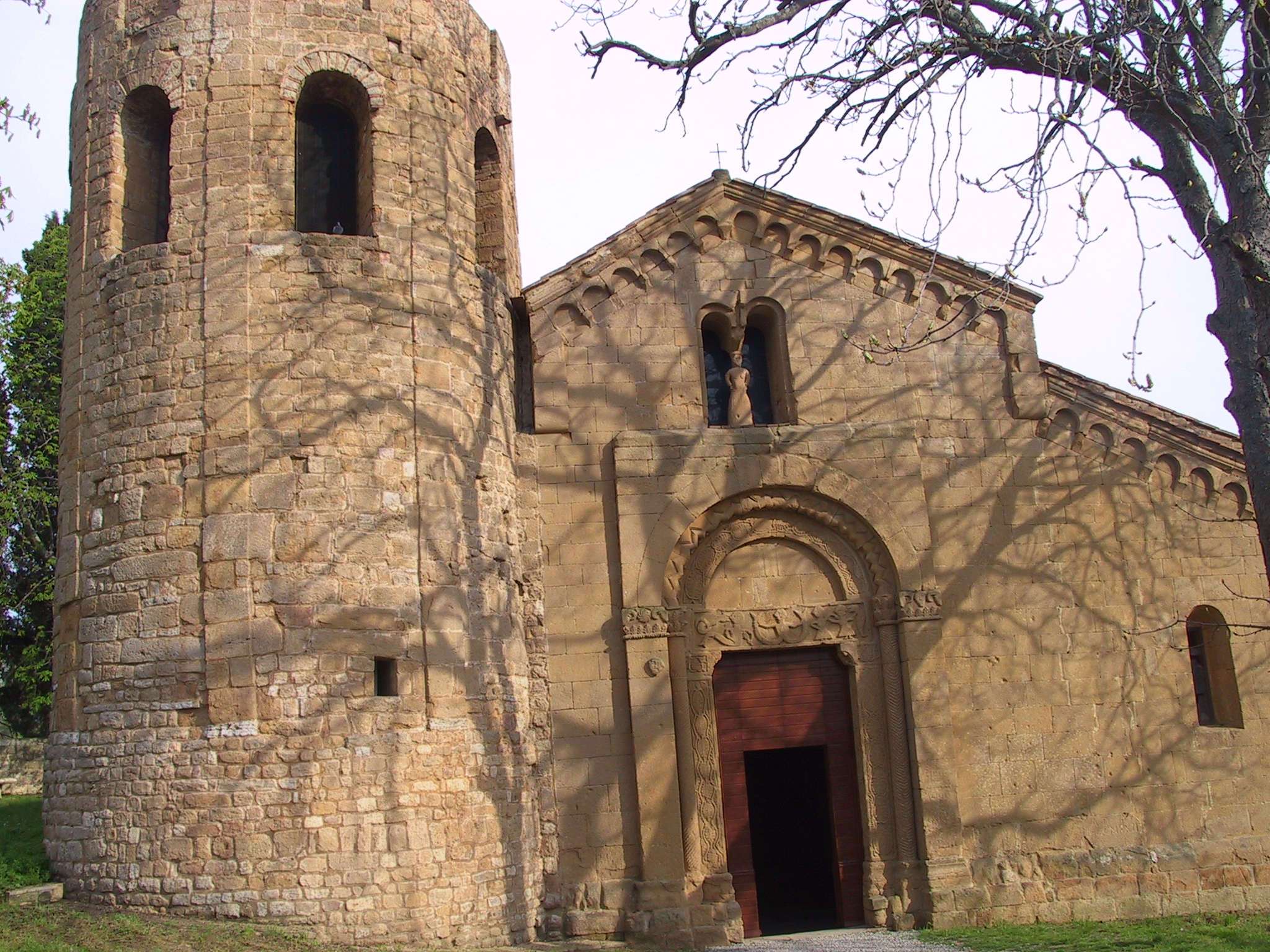
The small church (Italian: "pieve") of Corsignano - the alleged baptismal church of Pius II.
-- The small church of Pieve below Pienza, where he was baptized, has peculiar sculptures featuring serpent monsters and "vermin" (p. 61). WHAT is fact now?
See photos of this little church at Mossad Wikipedia:
https://fr.wikipedia.org/wiki/Pieve_di_Corsignano
And on one church door, one can see intertwined circles (serpent-like) combined with bent measuring rods and small animals within the circles, at the top right a lion and on the left a horse, on the crossbar 3 riders (holy 3 fantasy kings) and the scene in a house (in a fantasy stable).
Photo from Mossad Wikipedia: https://upload.wikimedia.org/wikipedia/commons/e/e7/Pieve_di_Corsignano_1.jpg
At the other church door, you can see plant reliefs, mermaids, and what stands out are 4 stone goats at the corners of the columns.
Photo by Mossad Wikipedia: https://upload.wikimedia.org/wikipedia/commons/4/4e/Pieve_di_Corsignano2.JPG
Above the second entrance is a double window, and its central column is depicted as an elevated woman ("Great Mother") (p. 61).
Photo by Mossad Wikipedia: https://upload.wikimedia.org/wikipedia/commons/6/60/Pieve_di_Corsignano.JPG
The columns in the church are said to carry "snakes and old pagan symbols" (p. 61).
I cannot see snakes
https://upload.wikimedia.org/wikipedia/commons/d/d7/Pieve_vito_e_modesto_interno.jpg
but a sun is engraved on a pedestal:
https://upload.wikimedia.org/wikipedia/commons/1/18/Interieur_de_l'%C3%A9glise_de_la_pieve_di_Corsignano.jpg
Uwe Topper concludes: This building is hardly recognizable as a church, if there weren't the 3 kings (p. 61)
[In other words: This building was probably also used for OTHER religions, for nature religions of the Italian indigenous people].
Other small churches in Tuscany
-- There are hundreds of such small churches in Tuscany with a layout and decoration of the "UNchristian kind" (cults of nature religions or indigenous peoples) (p.61)
-- these buildings seem to have been built [for cultures of before] (p. 61).
[Grosse Fotos sind in diesem Fall leider nicht auffindbar].
Pope Pius II as a WORLD forger - and the old churches were only partially "redesigned"
-- He had world history forged and published his action, a "redesign of world history on a grand scale" (p. 61)
-- Apparently he forgot the small churches of Italy (the "pievi") (p. 61)
-- Even some large churches in Tuscany have an "unchristian shape", such as "in San Chirico, where, apart from modern additions, nothing suggests the Catholic character of the building" but there are "monsters and mythical creatures" (p. 61)
-- Linking the mythical creatures to the FAKE Revelation of FAKE John is "far-fetched" (p. 61).
[Unfortunately, large photos are not available in this case].
-- The churches also contain works of art from the FAKE Antiquity, "Roman gems", which are crafted in exactly the same form as in the Catholic "Christianity", "as if only a few generations had passed between the Roman Antiquity and the Catholic Christianity of the 15th century". (p. 62)
4.5.C. Antonio de Guevara am Hof von Karl V. - ein "humanistischer" Geschichtserfinder - der Gipfel mit einem FAKE-Marc Aurel
[Ergänzung: Die Bevölkerung in Spanien amüsiert sich und staunt - gleichzeitig läuft der spanische Kolonialismus mit Völkermorden+Versklavung ab
ab 1539: Antonio de Guevara nach dem Königshof - ein falsches Vorbild
Die Lügen-Clown-Figur des Antonio de Guevara wird übersetzt - und nachgeahmt - Beispiele
4.5.D. Die FAKE-Tagebücher des Marc Aurel
Lügen-Nachahmer: "Humanist" Michael Schütz will ein "Tagebuch von Marc Aurel" erfinden
Lügen-Nachahmer: Da kommen Bücher zum Drucker Conrad Gesner in Zürich mit dem "Tagebuch von Marc Aurel"
Der FAKE-Marc Aurel (Marcus Aurelius Antoninus) und die Wirkung des FAKE-Tagebuchs von FAKE-Marc Aurel
4.5.E. Leute im Widerstand gegen die Lügenwelle bekommen "Schwierigkeiten": Wahrheitswisser und Logiker
4.5.A. Die moralischen Fürstenspiegel der Könige und Fürsten für ihre Söhne - und ihre Fälschungen
Fakers 4.5. [The invented] Marcus Aurelius, the Christian Emperor
Charles V and the Mirror of Princes by Antonio de Guevara -- the FAKE diaries of a FAKE Marcus Aurelius by forger Michael Schütz
4.5.A. The moral mirror of princes for kings and princes for their sons - and their forgeries
4.5.B. The Mirror of Princes for Charles V: The "Sundial of Princes" (orig. Span.: "Reloj de príncipes")
4.5.C. Antonio de Guevara at the court of Charles V - a "humanistic" historian - the pinnacle with a FAKE Marcus Aurelius[Note: The population in Spain is amused and astonished - at the same time, Spanish colonialism with genocides + enslavement is ongoingfrom 1539: Antonio de Guevara at the royal court - a false role modelThe lying clown figure of Antonio de Guevara is translated - and imitated - examples.
4.5.D. The FAKE Diaries of Marc AureliusLying imitator: "Humanist" Michael Schütz wants to invent a "Diary of Marc Aurelius"Lying imitator: Books are coming to the printer Conrad Gesner in Zurich with the "Diary of Marc Aurelius"The FAKE Marc Aurelius (Marcus Aurelius Antoninus) and the effect of the FAKE diary of FAKE Marc Aurelius
4.5.E. People in resistance against the wave of lies are facing "difficulties": truth-knowers and logicians
4.5.A. The moral mirrors of princes for kings and princes for their sons - and their forgeries
-- The "princes' mirrors" are moral booklets of kings and princes for their sons describing virtues, duties, and principles of proper governance. "Most princely mirrors originate from the Middle Ages and the Early Modern Period, but there were precursors in antiquity and, for example, an independent development in Byzantium." [web19]
-- With educational effect and moral benchmarks for the nobles and educated, addressed to the respective heir to the throne (p.62)
-- These Princes' Mirrors are idealizing the governance, and are depicting aklso real events and conditions of their time (p.62)
[And now one can imagine that 1) this was all only theory because the "Nobles" behave always as they want - and 2) the contents of these "princes' mirrors" also contained forgeries].
-- The most famous "prince's mirror" is that of Petrarch (Petrarca) (p.62)
-- In Byzantium and Persia, they exist from the 11th/12th century (p.62)
-- Princes' mirrors were intentionally "projected back into earlier epochs" in order to be considered as a "model of the ancestors" in order to "hold up a mirror to the present generation" (p.62)
-- Because the father alone has no high authority, but the authority is with the dead who are never considered to have weaknesses (p.62)
4.5.B. The Mirror for Princes for Charles V.: The 'Sundial of Princes' (orig. Spanish: 'Reloj de príncipes')
-- Emperor Charles V (HRR - in the "Holy Roman Empire" 1500-1558 [web20]) received such a "Mirror for Princes" from the Jesus-fantasy cleric Antonio de Guevara, who allegedly took 6 years to write it ("written 1518 to 1524") and named the work "Sundial of Princes" (Spanish: "Reloj de príncipes") (p.62)
-- This "sundial" for the empire where the sun never sets is the "greatest literary fiction of history" with biographical details from the life of the emperor, was translated throughout Europe, had the highest print runs like no work before it, and is also called the "Bestseller of the Renaissance" (p.62)
Antonio de Guevara: Mirror for Princes in English "Diall of Princes" (p.66) [chap4 photo2]
4.5.C. Antonio de Guevara at the Court of Charles V - a "humanistic" history fabricator - the peak with a FAKE-Marc Aurelius
-- Antonio de Guevara (1480-1545), the author, was already at the Catholic-Spanish court (at Isabel and Ferdinand of Castile) from the age of 12 [from 1492], during which the final destruction of the Muslim territories on the Iberian Peninsula was taking place (p.62) and he remained at court until 1538 (p.63)
-- During this time, colonialism began with Columbus, and around 1504 he became a "Franciscan monk" - in 1521, Charles V believed he needed a Jesus Fantasy preacher and appointed Guevara to his court for this purpose - from 1527 he also became the "official chronicler" at court - in 1528 his mirror for princes "Sundial" for Charles V was published - Guevara accompanied Emperor Charles V on all his travels, even on the expedition to Tunis in 1535 - in total, he was Karl V.'s "advisor" for 18 years, also served as a diplomat, was "inquisitor and peacemaker, personally baptized 27,000 Muslims [Berbers?] in Andalusia," ran his own printing press, "supplied hospitals and schools," loved writing and was a pioneer of the "modern novel" - in 1538 he resigned from his position at court (p. 63).
-- "Guevara was one of the most important men of his time; he held two bishoprics in succession and was regarded as a great role model by the humanists." (p.63)
-- The FAKE novel by Antonio de Guevara "The Golden Book of Marcus Aurelius Severus" was a great success, total Fantasy that was considered truth at the time - the FAKE sources were perhaps the Suda literary lexicon from Byzantium and FAKE letters from Marcus Aurelius - the novel was controlled and approved by Emperor Charles V. (p.63) - meaning: Antonio de Guevara established himself as a history creator like the other "humanists," but with a bit of "humor" mixed in - with "imperial blessing" (p.63-64).
[Addition: The population in Spain amuses themselves and marvels - at the same time, Spanish colonialism is ongoing with genocides and enslavement
The people in Spain were thus kept entertained with FAKE history and FAKE novels while the Jesus-fantasy "Christians" committed their massacres on other continents. The people in Spain were thus kept entertained with FAKE history and FAKE novels, while the Jesus fantasy 'Christians' carried out their massacres and genocides against the indigenous cultures on other continents and committed mass theft with gold and silver mines, etc., first in the Caribbean, then in Mexico, then up to Peru and Chile - without giving anything back to the indigenous people, but rather, high taxes were demanded from the indigenous peoples, and the 'Christians' robbed them of almost all their land (Link 1 - Link 2 - Link 3).
The nice "Christians" extorted the indigenous people into slavery and into the mines, which often collapsed and caused mass murder of men. The living conditions were so cruel that the population of the indigenous people even DECREASED, and only when this was reported to the court in Madrid in 1748 by Uolla and Juan in their report did the royal court react. This FACADE, to cover up colonial CRIMES, seemed also to be a function of "humanism" and the "Renaissance" - to create a FACADE with "beautiful" FAKE "literature", for that the new printing press was now good enough. In the meantime, the Emperor or king in Madrid - regardless of which - had NO overview of what was happening in the "colonies" in terms of genocide and enslavement. He controlled NOTHING, he never went to "America", but only looked at numbers reported by the colonial administration from Seville: So much silver was robbed from Mexico and Peru (for example at Potosí) that the price of silver collapsed worldwide. Charles V used the colonial profits for his wars in Europe - he was a total racist like everyone at all European royal courts - those who have weapons can do what they want, approved by the Fantasy god - understanding of culture and natural history did NOT come to "Christian" murder-Europe with the "humanists" but only from the 19th century with Alexander von Humboldt (1769-1859 - link) etc. The "humanists" were therefore NOT - or rather the term "humanist" is wrong, perhaps on purpose? "Humanists" were "history inventors" and protectors of colonialism: They COVERED with their amusing Fantasy works the "Christian" genocide colonialism. That would be the exact formulation and description for the "humanists"...]
[We continue with Topper about Antonio de Guevara entertainint the Spanish population with Fantasy FAKES from the imperial court]:
-- Antonio de Guevara published the FAKE "Family Letters" of the Emperor in 1539 and 1542 (2 volumes), which was once again a "huge success" across Europe (p. 64) - stylistically oriented toward the FAKE Cicero, they were pure FANTASY, written to the dead, containing "impossible events and timelines" (!) (p. 64)
-- Guevara's boldest lie was that he had "found" a manuscript of the FAKE Emperor Marcus Aurelius in the library of Cosimo de' Medici in Florence - the criticisms of being a "liar and forger" did not silence the lying Antonio; he simply continued as before (p. 64)
-- Antonio de Guevara also forged epitaphs (texts of gravestones) and other documents in his works of fantasy (p. 64)
-- There are more books from his side as, for example, "The Art of Navigation" or "The Decade of the Caesars," which were only recognized as FAKES after a long time (p. 64)
-- Criticism came, for example, from the "Humanist" Mr. Pedro de Rhua in the year 1540 in three letters appealing for "absolute honesty" to prevail in "such treatises" - but Guevara only responded "contemptuously and ironically", stating that he himself only believed in the FAKE Bible and that his works were just only Fantasy - and that was allowed (!) (p. 64)
-- The great masses uncritically loved his Fantasy, they considered him "an exceptionally clever mind", Guevara's fiction novels became a "standard of European poetry", and critics were dismissed as "grumpy" (p. 64)
[and Karl V. seemingly didn't care about any of this].
from 1539: Antonio de Guevara at the royal court - a false role model
-- The clown Antonio de Guevara allowed himself to publish a book in 1539 titled "Contempt for the Court and Praise of Simple Country Life," modeled after the FAKE-Horace, a fantasy created by a clown with "brilliant rhetoric" (p.64)
-- The subject of honoring the clown Guevara has been preserved in Spain to this day (as of 2000), as can be read in Spanish lexicons. Descriptions include
"genius writer"
"educated"
"parody of Humanism"
"capable" (p.64)"
"enriched the vernacular (popular) language [...]" (p.64-65)
"intelligent and educated"
"[The Emperor] Charles [V] himself supported him in this" (p.65)
The lying clown figure of Antonio de Guevara is translated - and copied - examples
-- Antonio de Guevara became a model, was translated, and is now also copied (p. 65)
[-- The art of humorous lying was thus imitated - where does this lead to? To the denial of reality and the tolerance of genocide colonialism - those who speak about the truth are seen as "killjoys" and "spoilsports" - and exactly THAT seems to have been intended]
-- Translations include, for example, in English "Golden Boke" (about Marcus Aurelius) from 1535, as well as the prince's mirror "Sun Dial" somewhat shortened under the title "The Diall of Princes" from 1557 (p. 65)
-- The critics in Europe did take certain data from Guevara seriously, namely his claims about the FAKE Emperor Severus regarding his ancestry, private teachers, and friends were regarded as "historical" and "became a standard of facts of the wisest of all Roman [FAKE] emperors, [FAKE] Marcus Aurelius, into historiography" (p. 65)
4.5.D. The FAKE Diaries of FAKE Marcus Aurelius
Liar-Imitators: "Humanist" Michael Schütz wants to invent a "Diary of Marcus Aurelius"
-- Michael Schütz (*Sterzing (South Tyrol) 1514, died in Hagenau (Lorraine) 1581 - poet and medical physician [web21]) was a "humanist and adventurer", called himself in a Greek manner "Toxita", claimed that in the library of Elector Ottheinrich of the Palatinate (Kurpfalz on the Rhine between Lorraine and Frankfurt [web22]) he had "received" a Greek FANTASY manuscript which contained a FANTASY copy of the "real diary of [FANTASY] Marcus Aurelius" (p. 65)
-- "Unfortunately, this manuscript also contained a life of Proclus by Marino [cannot be found], thus a humanistic work, and therefore the authenticity of the manuscript falls into the void." (p. 65)
Liar-Imitators: Here come books to the printer Mr. Conrad Gesner in Zurich with the INVENTED "Diary of Marcus Aurelius"
-- In 1945, printer Mr. Conrad Gesner in Zurich (1516-1565) received "a book by Marcus Aurelius", but was critical enough not to have it printed, as he recognized it as a forgery himself. (p.65 - Willy Theiler: Emperor Marcus Aurelius - 3rd edition 1984)
[Addition: Conrad Gesner
Conrad Gesner was "a Swiss medical physician, naturalist, classical philologist, humanist, polymath, and encyclopedist. His pseudonym was Euonymus Philiater, and his official botanical author abbreviation is "Gesner"." [web23] [There is no indication in the article of Mossad Wikipedia that he was also a printer].
[And he also liked to pass on lies so that the lies of others could be printed]:
-- Conrad Gesner also received the book from Michael Schütz (Michael Toxita) with the FAKE diary of a "Marc Aurelius", passed it on to his brother Andreas Gesner, and he made something out of it: He added more Latin translations to the book (Wilhelm Holzmann (Xylander) from Augsburg as well as Proclus of Marino 1559) - and so the book with the FAKE diary of Marcus Aurelius became a "bestseller without end (perennial favorite)" - in 1568 it was published for the second time in Basel, and "the original codex had already disappeared at that time. But in the Vatican there are supposed to be excerpts of parallel texts ("14th century"). (p.65)
-- It seems strange that the FAKE diary or the FAKE letters of FAKE Marcus Aurelius had never been known before (p.67)
-- The Aurelius FAKES were mentioned only by Augustine, who had the overview of the lying works of the "humanists" (see the book by Gleichen-Russwurm: Marcus Aurelius. Self-Reflections, 1913, Introduction - orig .German: Marc Aurel: Selbstbetrachtungen). (p.67, p.277), and more quotes are in the works of the FAKE bishop Arethas of Patras (10th century) (p.67)
The translations of the FAKE Marc Aurelius are often incomplete because "impossible content" is omitted:
-- The criminal pedophilia with boys is omitted, which was called "boy love" in those times... (p.67)
-- The denunciation of the "martyr addiction of the Christians" (p.67)
-- The condemnation of witchcraft and superstition (p.67) [while the Fantasy Jesus with Fantasy cross and Fantasy dead body and alcoholism with "holy wine" for reducing the brain is the worst superstition]
On the other hand, the honesty of writing about these topics is praised by others, e.g. by Capelle (Carl Capelle? 1841-1912, teacher, high school principal, classical philologist, commentator on Fantasy Homer [web24]). It is clear that these topics interested the "humanists" and were previously always in the taboo area (p.67).
The FAKE Marc Aurel (Marcus Aurelius Antoninus) and the effect of the FAKE diary of FAKE-Marc Aurel
-- is said to have lived from April 26, 121, to March 17, 180 [to the exact day, of course] (p. 67)
-- is said to originate from a "Spanish family" and is said to have been saved in 175 in a battle by his "Christian legion" [which battle?] (p. 68)
-- is said to have prevented the "persecution of Christians," although other sources state that FAKE Marc Aurel actually continued the "persecution of Christians," for example in Lyon in the year 177 (p. 68)
-- FAKE letters from "Christians" to FAKE Marc Aurel are cited, a FAKE Athenagoras warns of the "apocalyptic time" (p. 68)
-- FAKE Marc Aurel is thus portrayed as a "nearly Christian emperor," with a Fantasy god "in the singular" (p. 68), [this was fitting well into the Christian terror world with genocide colonialism starting in the 15th century, when the Fantasy god gives the "Christians" the right to divide the world and enslave it]
-- [But everything should be peaceful]: "The Christianized pagan philosophy expressed by [FAKE] Marcus Aurelius [in his FAKE diaries] knows only one world, one God, one nature of all living beings, one matter, one law and one reason." (p.68) [colonialism = reason - all right].
-- This FAKE Marcus Aurelius is becoming a new model for peaceful and rational life in the masses of the people, "a humanistically reformulated Jesus" with life contents of the 16th century [i.e. an instruction for life for the masses] (p.68)
-- The FAKE Marcus Aurelius allegedly died of the plague [German: Pest - which is not recorded anywhere in the FAKE Roman Empire] (p.68)
[-- The Latin and ancient Greek word for "plague" applies to every plague [web25]]
-- The FAKE Marcus Aurelius is venerated with objects which bear his FAKE name, deified to the maximum in paintings and sculptures, e.g. in the cr. Vatican with a FAKE bronze equestrian monument etc. etc. (p.68)
The FAKE Marc Aurel (Marcus Aurelius Antoninus) and the FAKE letters in Latin to his FAKE teacher Fronto
-- These FAKE letters are "flamboyant and childish,” hardly coming from a 25-year-old "philosopher" - are a "curiosity of the forgery guild" (p. 68)
[-- Those who search for "Fronto" will find many FAKE-Frontos - it is not clear which one is meant in connection with FAKE Marc Aurel [web26]]
-- The style of language and thought is completely different from the FAKE diary (p. 69)
-- However, classical studies continue to take them seriously: "They [the FAKE letters to FAKE Fronto] are often directly used for the purification of the (p.68) Self-Reflections, although they are written in a completely different style of language and thought and cannot possibly come from the same person." (p. 69)
4.5.E. People in resistance against the wave of lies face "difficulties": Truth seekers and logicians
-- Resistance came from people who recognized the systematic falsifications and insisted on truth and logic, facing difficulties (p. 69)
-- Resistance came from Mr. Lorenzo Valla (c.1406–1457, always in Rome, Italian humanist and [Jesus Fantasy] canon [web27]), who uncovered several forgeries and "got into great distress because of it" - in response, he tried to secure the Latin FAKE Bible (FAKE Vulgate [web28]) with the Greek FAKE original text of the FAKE Bible, which then brought him new "protectors" [you should pray and work and definitely not think, thus he fulfilled the crazy Jesus Fantasy Vatican dictatorship again!] (p. 69)
-- According to Mr. Uwe Topper, Mr. Poggio was another source investigator who even learned Hebrew for this purpose (p. 69)
Topper quote:
"Sharp critics had already begun to combat the general proliferation of forger's workshops by the end of the 15th century, fearing the loss of all standards. I will only mention Valla as the most famous, who uncovered several forgeries and thus got into great trouble. However, he attempted to secure the wording of the New Testament in the Vulgate against the Greek 'original text,' which ultimately provided him with powerful protectors. Poggio even strived to learn Hebrew, as he already suspected how important the use of 'first-hand' sources would be. But this step was only accomplished by the following generation." (69)
STRANGE:
According to Mossad Wikipedia, Gianfrancesco Poggio, in Latin: Poggius, 1380-1459 (Florence), was a "re-discoverer" [thus possibly also a FORGER]. His undeniable contribution to the world as "Apostolic [Jesus Fanatasy] Secretary" is the development of the Latin manner of writing: "Development of a clear, easily readable script." [web11]
Fakers 4.6. The fundamentalist Mr. Erasmus of Rotterdam
Translations of the FANTASY Bible by Erasmus of Rotterdam - the precursor to Luther
4.6.A. Life dates of Mr. Erasmus of Rotterdam - he was a fanatic of a Fantasy Jesus
-- Mr. Erasmus of Rotterdam is referred to as the "most famous humanist" - born in 1466 or 1469 [in Rotterdam] - lived in Paris from 1495 - wrote "in very good Latin" - lived in England from 1499 - learned Greek and wrote "rather decently" in Greek from 1502 (p. 69)
-- Erasmus was the author who in his work "The Praise of Folly" (in Latin) glorified criminal people, selling 20,000 copies of it in 11 years (p. 69)
-- A significant source on Erasmus of Rotterdam is the book by Mr. Hans Freiherr von Camphausen (ed.) (1991): "Take and Read! Christian Thinkers from Mr. Origen to Mr. Erasmus of Rotterdam"; Stuttgart 1991 (p. 69, p. 276)
(orig. German: "Nimm und lies! Christliche Denker von Origenes bis Erasmus von Rotterdam")
-- [Erasmus was NOT an Enlightenment thinker, but] he was a Fantasy Jesus fanatic - he believed that the Fantasy Jesus had already "guided the course of the world" before his FAKE birth, and he fought against Jewish influences in the FAKE Church (p. 69)
-- In 1516, he was "appointed as councilman" by Emperor Charles V - created the "Hieronymus edition of the [Jesus Fantasy] Bible in 9 volumes" - was the editor [FAKER?] of "nine early Christian [FAKE] authors" - while doing so, he "idealized an early Church", almost "romantically" [the FAKE gnosis] (p. 69)
-- In 1516 he published a New Fantasy Testament in Greek with a Latin translation, to assert himself against Spanish competition [from Charles V?] of the Complutense University of Madrid (1499 to 1836 in Alcalá [web29]) (p. 69-70)
[-- So the guy was totally LOST in his fantasy Jesus madness]
-- The Fantasy NT contained a "foreword" claiming to have "used many very old manuscripts" (p. 70), but:
Topper quote:
"But that is obviously a lie. He only had some young copies at hand, which were also full of errors and gaps. Whole groups of verses, such as the conclusion of the Revelation, had to be "back-translated" from the Latin Vulgate into Greek." (p. 70)
-- How he supposedly accomplished this work in half a year is, until then (as of 2000), unexplained - it is more likely that he used an already existing Greek and Latin Jesus Fantasy Bible and only commented on it. (p. 70)
-- What Mr. Erasmus really did and is proven, is the new shape of the Fantasy "Bible" ordering the work into chapters and verses - and this became the new standard. (p. 70)
-- Three years later, he published the Jesus Fantasy Bible just one time again, now "with 400 improvements", which was said to be used later by Luther for his translation into German [the new standard: Luther German]. (p. 70)
[One can only shake the head at the waste of time with these fantasies from FAKE OT and FAKE NT].
Theodor Beza with FAKE Bible
-- In Switzerland, it was Calvin's friend Mr. Theodor Beza (he died in 1604) who presented the Jesus Fantasy Bible in Greek and Latin, claiming it originated from the "5th century" - but it had the verse division that was only invented by Erasmus - Beza's version ultimately could not prevail (p. 70)
Theologians against Erasmus and Beza
-- The new mentality of reading the Jesus Fantasy Bible and accepting "solely the [FAKE] Scripture" provoked resistance among many Jesus Fantasy theologians, but the new mentality of directly reading the FAKE words of the fantasy God prevailed, and the FAKE Church had to accept this - the old "Church Fathers" lost significance (p. 70)
Forger 4.7. [England: The Fantasy] King Arthur is historically
A. FAKE Bible and its "versions" -- B. The INVENTED King Arthur of England with historian Geoffrey Ashe, who defends Fantasy as "inspiration"
4.7.A. FAKE Bible with the FAKE OT - always new versions
According to many theologians, the Old Moses Fantasy Testament of Judaism in Palestine is a "colorful mixture" of false memories, fairy tales, anecdotes, and sayings, as well as propaganda and distorted daily topics (p.71). This is not a singular opinion, but a standard, e.g.
-- with Mr. David Strauss around 1850 (1808-1874, always Ludwigsburg, German writer, philosopher, Protestant [Jesus Fantasy] theologian [web30])-
-- with Mr. Wellhausen (Gerhard August Julius Wellhausen (1808–1861), Protestant Lutheran [Jesus Fantasy] theologian, pastor, and cantor [web31]) and his circle of friends
-- with Mr. Delitzsch 1910 (for the name Delitzsch, two [Jesus Fantasy] theologians are listed, both of whom died before 1900 [web32])
-- The FAKE AT was partly tampered with and reshaped even 2000 years after the alleged events (p. 71)
-- Sometimes the Fantasy AT may contain "solid literature" and morally insightful processes of "timeless validity" (p. 71)
-- However, concerning the "historical truth content of the Bible", the following counts: "It is equal to zero" (p. 71) [the events are INVENTED]
-- All the scenes in Palestine are false, including the "'apocryphal" Maccabees books, which possibly depict battles up to the year 1000 in Palestine and were then "retroactively placed" (p. 71)
-- Some Jesus Fantasy story researchers passionately believe that the book "And the Bible is just Right" (orig. German: "Und die Bibel hat doch recht" - book by Keller) is relevant and even publish a book with this title establishing "appropriate cross-connections" that often turn out to be no evidence at all, because EVERYTHING IS FORGED, which the religious extremists refuse to acknowledge (p.71)
-- The belief in "the Greeks" is another example of superstition with legends, but evidence is lacking, such as archways with "Troy" on them or text plates with a FAKE Homer, which actually date back to 1200 BC (p.71, [web33])
-- The same mechanism today (as of 2000) is the search for an "Atlantis" - every new book with a new Atlantis claim sells well (p.71)
[Question: Why do the "Christians" still print the FAKE OT?
It raises the question of why this FAKE OT is still published together with the FAKE NT when many "'theologians" believe that only the "New Testament" should be "correct". The criminal "Christian" theologians are abusing the FAKE Old Testament to always have a "negative example", but if all of that is forged, then every argument there is also incorrect and USELESS. It shows that the "theologians" are not more intelligent...]
4.7.B. The Fantasy King Arthur of England (Artus)
[Summary:
According to Mossad Wikipedia, "King Arthur" is a legendary figure from the FAKE "Middle Ages", appearing in various contexts and meanings - supposedly lived in Britain in South England, which had been occupied by FAKE Rome - British FAKE chronicles claim successful defensive FAKE wars under FAKE Arthur against FAKE attacks from continental Europe around the year 500 AD (Angles, Jutes, and Saxons) starting in the 9th century - from the 12th century, this defense story is adopted into the "courtly literature of Central Europe", embellished and brought into "classic form" [Mossad Wikipedia - web34]
The FAKE "King Arthur" for England - as a counterpoint to the German-French FAKE "Charlemagne"
-- One can also see how such a myth is created with the FAKE King Arthur (p. 71)
-- Some historians consider King Arthur to be a "historical figure of the 5th century", for example in the book by English historian Geoffrey Ashe (1923-2022 [web35]): King Arthur. The Discovery of Avalon (Düsseldorf 1986) (pp. 71, 275)
-- However, the first mentions of a "King Arthur" only appear in FAKE novels starting in 1130, where "King Arthur" is placed among the Goths, Huns, and Vandals during the "Migration Period" and has since been "exercising historical function" (pp. 71-72)
-- "King Arthur" is the INVENTION of an English heroic figure as a parallel to the FAKE Charlemagne in Germany and France, and he was also attributed a bit of imperialism with the occupation of Brittany and parts of France up to Burgundy, in the style of a "Germanic warlord", authorized by a "Roman [FANTASY] emperor" (p.72).
-- Historian Mr. Ashe ultimately places "King Arthur" in the 5th century to fit the setting, using novels from the 12th and 13th centuries as "sources" - and thus Mr. Ashe betrays his own scholarly rigor - but the aim is achieved: "King Arthur" has become a "historical figure" - the "wished king of the knightly era" has finally become real, the first great FAKE king of England after FAKE Antiquity (p. 72).
Details:
-- A FAKE Godfrey from Monmouth (in Wales [web36]) INVENTED a story of the INVENTED kings of Britain, allegedly published in 1136 (p. 72)
-- The original has DISAPPEARED of course, and the story exists only in a "later revised version" (p. 72)
-- Historian Geoffrey Ashe (1923-2022 [web35]) assumes that the FAKE Gottfried from Monmouth had also been the "reviser" (p. 72)
-- The FAKE Arthur is prominently mentioned in this Fantasy story, all kings before and after him are "smaller" (p. 72)
-- The FAKE kings of England begin at the time of the "fall of Troy [fantasy]" - in the 12th century, this Fantasy was a "fixed point" among historians (p. 72)
-- The Fantasy fall of Troy is said to have occurred around 1150 before Fantasy Christ - and Godfrey is supposed to have written his work around 1150 after Fantasy Christ - the Fantasy Jesus is to stand as the "axis and center of the temporal world" (p. 73)
The FAKE Gottfried is reporting us that:
-- The FAKE Aeneas emigrated to Italy (p. 73)
-- The FAKE great-grandson of FAKE Aeneas, Brutus, moved to England, cleared it of giants, populated it, and named the island after himself - he founded "New Troy" on the Thames, which later became London (p. 73)
-- Now 75 FAKE-kings are said to have ruled England - "with names and deeds" -- "the finest tapestry of legends" (p. 73)
-- Historian Mr. Ashe comments: "Almost all of them were products of his imagination [...] (quoted from the German translation by H. Stadler, p. 17)' (p. 73)
-- "Also, a flying Wieland or Daedalus, here called Bladud, is not missing. He crashed over New Troy." (p. 73)
-- The FAKE Bladud had a FAKE son King Lear, who reigned in the 8th century before Fantasy Jesus (p. 73)
-- There are used "well-known legendary figures" and original, mostly "speaking" names, embodying the attributed characteristics, as is often the case in such poetry (p. 73)
-- The Fantasy tales therefore confirm each other (p.73)
-- The fantasy dog of Fantasy Arthur is referred to as "Cabal", alluding to "Cerberus" - in accordance with the sound laws concerning the R-L development (p.73)
-- One could expect that Gottfried would also invent stories about the Fantasy Romans with Caesar, Claudius, and Trajan, but he does not: According to Gottfried, "the conquest of England by the Romans did not take place at all [...] as the ruling kings of England paid their tribute to the [Roman fantasy] Emperor willingly" (p.74)
-- Thus, the Fantasy Gottfried denies the Fantasy Romans any "civilizing work" in England (!) (p.74) [because Celts had a good civilization, Romans were not needed]
-- Historian Mr. Ashe, on the other hand, is going on telling that there had been a Fantasy occupation by the Fantasy Romans (p.74)
-- Mr. Fantasy Gottfried then presents the traditional assessment of the different peoples: Catholics are the "good ones" [killing around committing genocides all over the world], and all peoples of other faiths are "heathens" and thus "barbarians" (p.74)
[We know exactly who the barbarians are: the people of Christian colonialism and those of Christian NATO with their genocides].
Topper quote:
"Now comes the Catholic rating [of naive historian Mr. Ashe]: All pagans should be barbarians, thus Picts, Scots, and Saxons; and all Celts should be Christians [the "good ones"]. Well, there are NO findings about any [Jesus Fantasy] Christianity in England for the 5th century, and Mr. Ashe knows this, but he goes on to tell that there had been [Jesus Fantasy] Christianism in this period. Because: It is substantiated by written [FAKE] sources." (p.74)
"Written sources" can be forged by anyone - clearly:
-- There is the indication that a [Jesus Fantasy] "Archbishop of London" in the 4th century was in danger and had organized troups from Brittany (Bretagne) against "pagans in England" (p.74)
-- Not only that, but also any "kinship of the Bretons with the Britons" is only INVENTED (p.74)
Topper quote:
"A [Jesus Fantasy] Archbishop of London in the 4th century seeks reinforcements from Brittany against the pagans in England. The constructed kinship of the Bretons with the Britons is indeed a well-known motif to this day." (p.74)
In detail, it looks like this:
-- A brother of the King of Brittany - a "Constantine" (!) - moves to England - his son helps to defeat the "barbarians" and is Fantasy crowned in the year 407 as Fantasy King of England - his Fantasy son is Fantasy Arthur (p. 74)
-- The Fantasy coronation of 407 takes place in the same year as the victory of the Visigoths in Spain against the Roman Fantasy Empire - there is no mention of bloodshed (p. 74)
Topper quote:
"Constantine, a [Fantasy] brother of the Breton [Fantasy] king, moves to England, whose son triumphs over the [Fantasy] barbarians and is crowned for being a [Fantasy] king, precisely in the year 407, in which — Godfried surely knew this from Isidore — the Visigoths moved from the Rhine into Spain and robbed the [Fantasy] Romans of these provinces. The historian's revenge is sweet, because all this happens without any bloodshed. The [Fantasy] son of this [Fantasy] barbarian conqueror is [Fantasy] Arthur. If everything up to this point was invented, then we are now in the midst of the historicity." (p. 74)
Fantasy sources for the Fantasy Arthur: Jesus Fantasy bishop of Clermont Sidonius Apollonius (Fantasy) - with Jesus Fantasy abbot Faustus (another Fantasy) - 2 "writers"
-- Historian Geoffrey Ashe tells us that a Fantasy bishop of Clermont (Sidonius Apollonius, bishop since 470) could serve as a source (!), this bishop made a career as a "saint" and as a "writer" - after all, he was a "contemporary of [Fantasy] Arthur" - he was indeed a "[Fantasy] eyewitness of his great [Fantasy] deeds" (p. 75)
-- Sidonius is said to have been the Fantasy son-in-law of the western Roman Fantasy emperor - and is said to have had "[a Fantasy] correspondence with many [Fantasy] people," including the Jesus Fantasy abbot [Fantasy] Faustus in southern France, also a Fantasy "writer" (p. 75)
-- Historian Ashe notes about the works of Fantasy Sidonius: "Some books written by him have survived (Book: The Discovery of King Arthur 1986, p. 66) (p. 75)
-- Topper clearly says about the Fantasy works of Sidonius that "only three poems and nine volumes of letters in pompous and tasteless style have survived, and these were probably written only in the Renaissance" (p.75)
-- A cr. poet of the Renaissance wrote Fantasy letters for Sidonius, with "gigantic ostentation" and invented scenes: a man is stealing a book and was chased for that, the saved book is dictated to several scribes, etc." (p.75)
Fantasy sources for Fantasy Arthur: Fantasy Nennius (800-820 [?]) - Fantasy Gildas (before 800) - Fantasy Cambria (around 900)
-- A Fantasy Nennius supposedly lived to be only 20 years old and is said to have authored a "History of the Britons" (p. 75)
-- A Fantasy Gildas is invented by a Fantasy Nennius (p. 75)
-- A Fantasy Cambria is invented with Fantasy Annals around 900 "a century later" (p. 75)
-- They have one thing in common: "They are all full of horror stories" (p. 75)
-- Fantasy Arthur is referred to in these works as "the soldier" and never as a "king" or even as "ameradeur," in French this word is similar to "maraudeur," meaning "highwayman, robber" (p. 75)
-- Historian Mr. Geoffrey Ashe lets his Fantasy play claiming that this word would be "a distortion of IMPERATOR", "emperor" (p. 75 - Book: The Discovery of King Arthur 1985: p. 94)
Fantasy sources for the Fantasy Arthur: there is a FAKE exchange of enemy images - "fiction" is said to be "inspiration" (?!)
-- And if the Fantasy really seems unlikely, historian Mr. Ashe has another "interpretation" in store: then the "enemy images" are simply exchanged (p.75).
Topper quote:
"But when there are too many contradictions, Mr. Ashe has the idea to exchange the enemy images is not unknown in heroic literature when history demands it." (p.75)
Example "Song of Roland":
-- Such an exchange of enemy images occurs, for example, with the Fantasy Roland Song, the paladin (high noble man) of Fantasy Charlemagne, where the Basques suddenly become Saracens (p.75 - Book: The Discovery of King Arthur, German version, p.121)
-- Also here, ALL is JUST A LIE and INVENTED, "because Roland and Charlemagne's Pyrenean campaign are Romance novels of the 12th century being used for manipulating the fighting spirit (p.75) of knights against Saracen enemies. That is the only fact that a scholar can have as an interpretation from the Song of Roland." (p.76)
Fantasy sources for the Fantasy Arthur: The Fantasy Arthur is sometimes also a Fantasy Riothamus
-- Historian Mr. Ashe quietly admits elsewhere that the story is "fiction", but the Fantasy Arthur with his "Gallic adventures" is still a reminder of the Fantasy Riothamus, and thus the "source of this inspiration is beyond doubt, even if Geoffrey (for example Godfrey) is manipulating the facts, is exaggerating the facts, is distorting the facts." (p.76 - Book: The Discovery of King Arthur, German version, p. 120).
-- Thus, INVENTIONS are regarded as "facts" in an arbitrary chronology - as an "inspiration" - THIS is "English history" according to historian Ashe (p.76)
-- Historian Ashe cites, for example, a Sharon Turner, who describes a Fantasy expedition of a Fantasy King Riothamus: With 12,000 soldiers [code 12, the dozen, the "perfect" number] he is said to have rushed to help the Fantasy Emperor of Fantasy West Rome - not only that: Riothamus is said to be Arthur (p.76).
Topper quote:
"Thus, he [historian Ashe] also uses a certain Sharon Turner, who describes an expedition of King Riothamus, who rushes to help the emperor of the Western Roman Empire in Gaul with 12,000 soldiers [Code 12=a dozen] in his "groundbreaking work of scholarship" (Book: King Arthur, German version: p. 123). Turner equates Riothamus with King Arthur, and for Ashe, this becomes the basis of his thesis, although the highly learned Mr. Turner places Arthur in a much later time." (p. 76)
-- However, the imaginary Riothamus must have existed, which is confirmed by the imaginary letter of the imaginary Sidonius, according to Topper an "absolutely childish fiction" (p. 76)
Topper quote:
"The main [Fantasy] evidence for [Fantasy] Riothamus, the "illustrious [Fantasy] king", is that letter from [Fantasy] Sidonius, which in my opinion is an absolutely childish fiction, more amusing than worth investigating." (p. 76)
Topper's closing words on FAKE Arthur:
"At this point, I conclude my brief critique of Ashes' book. I believe it has become clear how historians proceed when they want to extract history from epics." (p. 76)




|
|
|
Sources
[web01] https://de.wikipedia.org/wiki/Konrad_Peutinger
[web02] https://de.wikipedia.org/wiki/Leontius_Pilatus
[web03] https://de.wikipedia.org/wiki/Dante_Alighieri
[web04] https://de.wikipedia.org/wiki/Giovanni_Boccaccio
[web05] https://de.wikipedia.org/wiki/Cosimo_de'_Medici
[web06] https://de.wikipedia.org/wiki/Marsilio_Ficino
[web07] https://de.wikipedia.org/wiki/Bessarion
[web08] https://de.wikipedia.org/wiki/Hrabanus_Maurus
[web09] Christph Pfister: Die Matrix der alten Geschichte, S. 28-29
[web10] https://de.wikipedia.org/wiki/Francesco_Petrarca
[web11] https://de.wikipedia.org/wiki/Poggio_Bracciolini
[web12] https://de.wikipedia.org/wiki/Giovanni_Aurispa
[web13] https://de.wikipedia.org/wiki/Nikolaus_von_Kues
[web14] https://de.wikipedia.org/wiki/Matthias_Corvinus
[web15] https://en.wikipedia.org/wiki/Francesco_Sassetti
[web16] https://de.wikipedia.org/wiki/Bobbio
[web17] https://de.wikipedia.org/wiki/Pius_II.
[web18] https://de.wikipedia.org/wiki/Gemme
[web19] https://de.wikipedia.org/wiki/Fürstenspiegel
[web20] https://de.wikipedia.org/wiki/Karl_V._(HRR)
[web21] https://de.wikipedia.org/wiki/Michael_Toxites
[web22] https://de.wikipedia.org/wiki/Kurpfalz
[web23] https://de.wikipedia.org/wiki/Conrad_Gessner
[web24] https://de.wikipedia.org/wiki/Carl_Capelle_(Pädagoge,_1841)
[web25] https://de.wikipedia.org/wiki/Pest
[web26] https://de.wikipedia.org/wiki/Fronto
[web27] https://de.wikipedia.org/wiki/Lorenzo_Valla
[web28] https://de.wikipedia.org/wiki/Vulgata
[web29] https://de.wikipedia.org/wiki/Universität_Complutense_Madrid - https://de.wikipedia.org/wiki/Universität_Alcalá_(historisch)
[web30] https://de.wikipedia.org/wiki/David_Friedrich_Strau%C3%9F
[web31] https://de.wikipedia.org/wiki/Wellhausen
[web32] https://de.wikipedia.org/wiki/Delitzsch_(Begriffsklärung)
[web33] https://de.wikipedia.org/wiki/Homer
[web34] https://de.wikipedia.org/wiki/Artus
[web35] https://en.wikipedia.org/wiki/Geoffrey_Ashe
[web36] https://en.wikipedia.org/wiki/Monmouth